
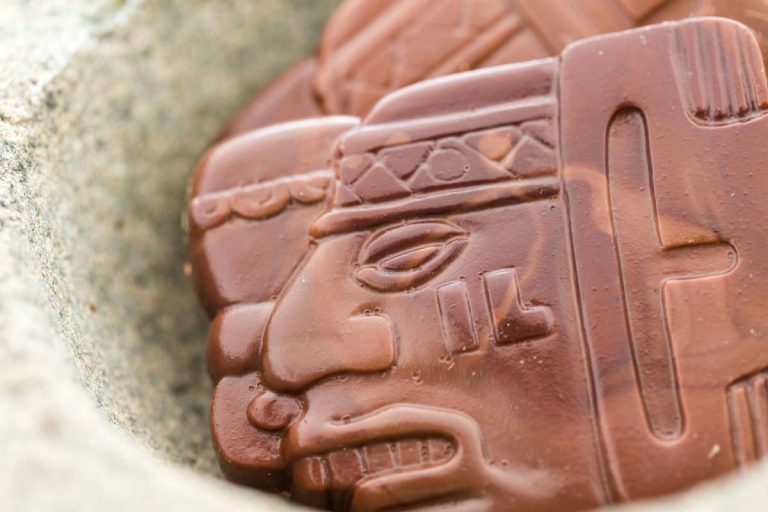
Chocolate, although considered today as a delicious treat, finds its origins in the depths of the Mayan civilization. The Mayans, one of the most advanced pre-Columbian civilizations in Central America, were among the first to discover the virtues of cacao. This plant, which would become sacred in their eyes, has a history closely linked to Mayan culture, religion, and economy. The cacao tree (Theobroma cacao), a remarkable tree of tropical forests, caught the attention of the Mayans with its beans. These were hidden in pods ranging in hues from green to bright red. It is by observing animals, especially monkeys, that the Mayans noticed the consumption of cacao pulp. Gradually, they realized that the beans themselves could be transformed into a precious substance. Cacao cultivation spread throughout the Mayan region, adapting to low-altitude soils and humid climates. The Mayans were ingenious farmers, using tailored techniques to maximize cacao production. They often planted cacao trees in the shade of taller trees to protect them from direct sunlight, thus creating complex agroforestry systems. Harvesting cacao pods, opening them to extract the beans, and then fermenting and drying them were crucial initial steps that the Mayans mastered. Thus, cacao was not just a simple food: it quickly became an integral part of Mayan culture, with multiple profound meanings.
The ancestral chocolate-making process by the Mayans deserves our attention to understand how a simple bean can transform into an energetic and symbolic drink. After being extracted from the pods, cacao beans had to go through a meticulous series of steps to become what the Mayans called ‘xocoatl’. The first crucial step was the fermentation of the beans. The Mayans allowed them to rest in large containers, often covered with banana leaves, for a period ranging from several days to a week. This natural fermentation enhanced the flavors while reducing the beans’ bitterness. Next, the beans were sun-dried, a simple yet effective method to preserve their qualities. Once the beans were fermented and dried, they were roasted. Roasting took place in large ceramic pots or on heated stone slabs. This process aimed to intensify their flavor. After roasting, a laborious grinding process began. Cacao beans were crushed using flat, concave stones called metates. While grinding, the Mayans sometimes added ingredients like chili, vanilla, or flower petals, creating a rich and complex mixture. The result of this operation was a thick paste called ‘cacao paste’. To prepare their sacred beverage, they mixed this paste with water, often warm or hot, vigorously stirring the mixture with a sort of small stick called ‘molinillo’ to obtain a frothy texture essential for ritual consumption. This drink was far from our modern sweet hot chocolate. It was bitter, spicy, and often intended for ceremonial and medicinal uses. The chocolate-making process among the Mayans was thus much more than a mere physical transformation of the beans: it was an art, a secretly kept and respected tradition.
In Mayan civilization, chocolate was not just a drink; it was also a central element in their religious rituals and spiritual beliefs. The Mayans considered cacao a gift from the gods, particularly from the feathered serpent god Kukulkan, and attributed supernatural powers to this plant. Mayan religious ceremonies were often punctuated by the use of chocolate. During marriage rituals, for instance, chocolate was offered to the gods as a blessing and then shared between the spouses to seal their union. This drink was also used during initiation ceremonies and rites of passage. By drinking chocolate, participants believed they received a share of the divine energy, thereby strengthening their spirit and courage. Cacao-based offerings were common. Mayan priests used specially decorated containers to place cacao paste or liquid chocolate on dedicated altars, where they implored the gods for abundant harvests, rain, or victory in battle. Cacao was also spread on human or animal sacrifices, considered a sacred offering to ensure the bond between the earthly world and the deities. Chocolate also played a daily spiritual role. Mayan nobles and warriors regularly consumed it to maintain their vigor and clear their minds. This drink was believed to enhance concentration and endurance, essential attributes for those who had to lead or fight. Ritual songs and dances, often accompanying chocolate consumption, were magnified by cacao’s stimulating effects. Cacao was perceived as a soul stimulant, capable of transporting participants to a state of meditation or trance, thus facilitating communication with ancestors and cosmic forces. The spiritual importance of chocolate in Mayan culture cannot be underestimated. It was a cornerstone of their approach to the sacred, allowing them to maintain a constant and deep connection with the forces governing their world.
Besides its religious and spiritual uses, cacao held incredible economic value in Mayan society. What might have been perceived by other cultures as a mere bean was, for the Mayans, a precious exchange currency and a prime commodity in their trade networks. Cacao beans were used as actual currency. The Mayans had established a sort of ‘exchange rate’ between cacao beans and other goods and services. For example, one could trade a handful of cacao beans for a rabbit, a turkey, or clothing. A thriving market existed around cacao, facilitating internal trade but also exchanges with other Mesoamerican peoples, such as the Aztecs. Nobles and the upper classes also used cacao beans to pay taxes or tributes owed to lords and kings. Records show that some Mayan city-states received thousands of beans as payment each year, highlighting the economic importance of this raw material. Cacao, in this sense, went far beyond a simple consumer product: it formed the backbone of the Mayan economy. The cacao trade was not limited to local distribution. The Mayans used land and river trade routes to transport cacao over long distances. These routes facilitated exchanges with other civilizations, such as the Toltecs and the Aztecs. Merchants transported beans in large fiber bags, navigating on canoes along rivers and coasts to reach distant markets. The use of cacao as currency and merchandise thus helped weave a complex and interconnected trade network, ensuring the circulation of goods, ideas, and innovations across Mesoamerica. This versatile use of cacao highlights just how advanced Mayan society was in structuring and regulating its own economy.
The impact of Mayan chocolate still resonates worldwide today. This revered drink, once mysterious and sacred, has traversed eras to become a global industry while retaining its essence and unique appeal. When European explorers discovered the New World, they in turn were fascinated by chocolate. Spanish conquistadors, in particular, brought cacao to Europe in the early 16th century. Quickly, the bitter drink was adapted to the European palate by adding sugar and other flavors, thus initiating a culinary transformation. The first chocolate shops emerged, and soon Europe adopted this exotic beverage, enriched with local influences. However, the Mayan techniques and rituals of chocolate preparation served as the foundation for this evolution. Roasting, grinding, and the initial mixing of cacao are practices that have been respected and adapted over the centuries. In France, Switzerland, or Belgium, master chocolatiers continue a craft that, in hindsight, finds its roots in Mayan artisanal sophistication. Moreover, chocolate has gained universal cultural significance. Festivities like Valentine’s Day or Easter make chocolate a symbol of affection and celebration, far removed from its ritual origins but always laden with deep meanings. In every bite of contemporary chocolate, there is a part of Mayan history. Cacao, the Mayan legacy, is also a witness to current economic and ecological challenges. The growing global demand for chocolate raises questions of sustainability and fairness, reminding us that cacao, once used as currency, remains a precious and sometimes contested resource. By celebrating chocolate today, whether by savoring a bar crafted by an artisan or enjoying a hot drink, we maintain a connection with the Mayans. Their innovation, culture, and passion for cacao transcend time, enriching our lives and taste buds, demonstrating the enduring power of this ancient treasure.